Falls prevention focuses on indoor falls, but outdoor falls are just as severe.

Continuing our work on pedestrian falls we just published a paper in Injury Epidemiology focused on describing the clinical severity of injurious falls, distinguishing between falls that occur indoors and those that occur outdoors.  While falls prevention guidelines focus on indoor falls, we show that the proportion of falls that cause severe injuries is similar for indoor and outdoor falls.

Given the large numbers of falls that occur indoors and among older persons, it is reasonable that fall prevention guidelines and research have almost exclusively focused on these indoor falls. However, given the comparable trauma severity of injurious falls that take place on streets or sidewalks to those that occur indoors and that injurious falls are expected to increase as the population grows older, we argue that greater research attention to pedestrian falls is urgently needed to inform outdoor fall prevention guidelines. Specifically, research should focus on identifying environmental, temperature, season, and built environment risk factors for injuries from pedestrian falls.
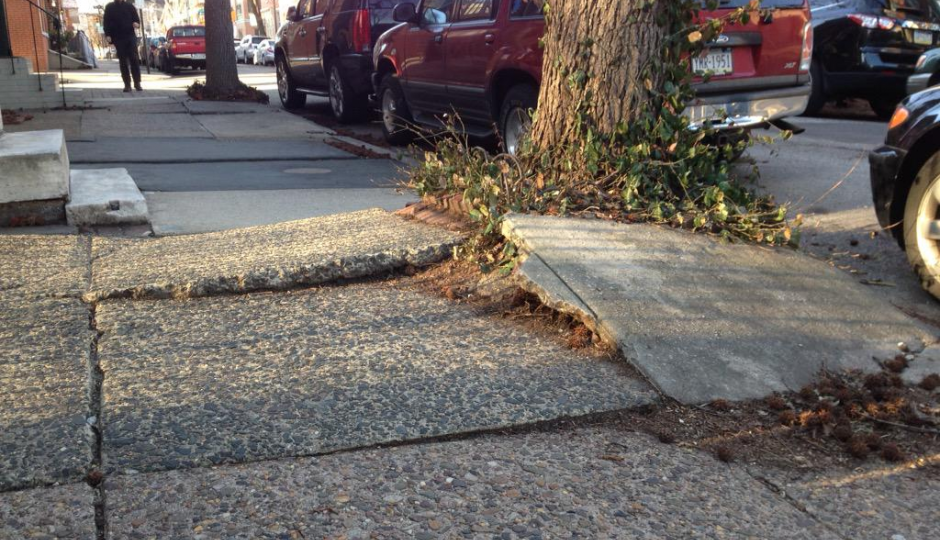
Image embedded from a 2015 article in PhillyMag on sidewalk hazards – 10 years later the problems remain.

This study builds off the methodology developed in our previous work to identify injurious falls by indoor versus outdoor location using Emergency Medical Services data from the 2019 National Emergency Medical Services Information System (NEMSIS) database. Here we classified the clinical severity of injurious falls using three injury severity measures that are used in the clinical setting to help guide the care response of on-scene EMS: (1) the Revised Trauma Score for Triage (T-RTS) (2) Glascow Coma Scale (GCS) and (3) patient clinical acuity. For injured patients who fell indoors vs outdoors on streets or sidewalks, the proportions were comparable for GCS scores in the moderate or severe range, T-RTS scores indicating need for transport to a Trauma Center, and EMS acuity rated as Emergent or Critical. The proportion of severe outdoor falls on streets and sidewalks was higher among men compared to women. The severity of injurious falls on streets and sidewalks was greater for young and middle-aged adults than injurious indoor falls but this pattern was reversed for older adults.

BEH team members Katie Burford and Nicole Itzkowitz led this research.

Posted in Injury, Pedestrian Injury, Physical Activity, Safety, Walkability | Leave a comment

Alcohol involvement in cyclist injuries

We are expanding our work on the link between nightlife establishments, nightlife districts and pedestrian injury from motor vehicles to include cyclist injuries.  Our first paper on cyclist injuries compared estimates of the proportion of cyclists injured while under the influence of alcohol across three publicly available datasets. 

Many cities, as part of economic development plans to revitalize urban centers, are now developing and promoting nightlife and nightlife districts, prominently featuring alcohol-serving establishments, which encourage patrons to walk between nearby alcohol serving venues. At the same time, US cities are also increasing the availability of bike share systems which are typically placed near restaurants/bars, and commercial/downtown areas. These economic and policy initiatives are likely to increase the number of pedestrians and cyclists under the influence of alcohol and at risk of injuries from motor vehicles.

Alcohol involved fatal and non-fatal injuries to pedalcycle riders (≥21 years) were identified in three public data sets from 2019: the National Emergency Medical Services Information System (NEMSIS); the Fatality Analysis Reporting System (FARS); and the National Electronic Injury Surveillance System (NEISS) datasets. In NEMSIS, which reports on EMS deployments, 10.2% of the cases of injured cyclists were noted as involving alcohol. The NEISS data set, which provides data on patients presenting at EDs, showed that 7.3% of cyclist injuries involved alcohol. While the FARS data showed that alcohol was involved in 27.0% of cyclist fatalities from motor vehicle crashes. Regardless of the data source, cyclist fatal and non-fatal injuries were more likely to involve alcohol among middle-aged adults compared to older and younger aged adults, and for men compared to women, with rates that were generally 3-8% higher for men.

The analyses of these three datasets shows estimates of the extent of alcohol involvement in pedalcycle injuries vary substantially across national public-use datasets. Standardized, valid, and feasible methods to measure alcohol involvement in pedalcycle injuries are needed to accurately inform injury prevention efforts.

Posted in Active Transport, Alcohol, Bike Share, Bikeshare, Injury | Tagged , , , , | 1 Comment

The Burden of Pedestrian Falls on Streets and Sidewalks in the U.S.

After doing substantial work documenting the links between greater neighborhood walkability and higher engagement in pedestrian activity and reduced weight gain, in recent years we have launched research projects on pedestrian safety.  In new work just published in the Journal of Urban Health, we show that the population burden of injuries to pedestrians from falls on sidewalks and streets is substantially higher than the burden of injuries to pedestrians from motor vehicles.  This was especially true for pedestrians age 50 years or older.

For the research, data on injurious falls on streets and sidewalks, and pedestrian-motor vehicle collisions, to which Emergency Medical Services responded, along with pedestrian and incident characteristics, were identified in the 2019 National Emergency Medical Services Information System database. In total, 118,520 injurious pedestrian falls and 33,915 pedestrians-motor vehicle collisions were identified, with 89% of the incidents occurring in urban areas. Thirty-two percent of pedestrians struck by motor vehicles were coded as Emergent or Critical by Emergency Medical Services, while 19% of pedestrians injured by falls were similarly coded. However, the number of pedestrians whose acuity was coded as Emergent or Critical was 2.1 times as high for injurious falls as compared with pedestrians-motor vehicle collisions. This ratio was 3.9 for individuals 50 years and older and 6.1 for those 65 years and older.

With the vast majority of injury occurring in urban spaces, the data suggests that urban design, policy, and built environment interventions are important tools for reducing pedestrian fall related morbidity. There has been substantial and appropriate policy attention given to preventing pedestrian injuries from motor vehicles, but disproportionately little to pedestrian falls. We argue that this likely arises from differences in who is responsible for, and who pays for, sidewalk maintenance – individual property owners – and road maintenance – local governments. However, the population burden of injurious pedestrian falls is significantly greater than from pedestrian-motor vehicle injuries and justifies an increased focus on outdoor falls prevention than currently exists across the USA.

Posted in Active Transport, Adults, Pedestrian Injury, Physical Activity, Safety, Transportation, Urban Design, Walkability | Leave a comment

Higher Neighborhood Walkability is Associated with Lower Risk of Obesity Related Cancers

In collaboration with colleagues at the NYU Women’s Health Study we recently published analyses showing that higher neighborhood walkability is associated with lower risk of obesity related cancers.  Fourteen thousand women were recruited into the study between 1985 and 1991 and followed-up for cancer incidence through 2017.  The participant’s residential histories were compiled throughout this period and the walkability of their Census Tract of residence was measured.  Analyses of the data showed that higher average annual neighborhood walkability during follow-up was associated with lower risk of obesity related cancers. Women with average annual neighborhood walkability score in the top quartile of walkability had a 26% lower risk of obesity-related cancer and a 27% lower risk of postmenopausal breast cancer, compared with women with average annual neighborhood walkability score in the bottom quartile.

One of the long-term goals of the BEH project has been to show how urban design impacts cancer outcomes.  Obesity increases the risk of 13 types of cancer in women, and physical activity lowers the risk for some of these cancers, independent of body size.  Over the years we have shown that higher neighborhood walkability is associated with higher levels of pedestrian activity and overall physical activity and lower body mass index (BMI), lower weight gain and lower obesity risk.  Now, with our collaborators, we have shown in the NYU Women’s Health Study that higher neighborhood walkability is associated with higher levels of walking and lower BMI when the women entered the study and lower obesity related cancer risk over 30 years.     

Posted in Active Transport, Body Mass Index, Cancer Incidence, Obesity, Physical Activity, Urban Design, Walkability | Leave a comment

Eliza Kinsey launches new research on addressing food insecurity among chronic kidney disease patients

Not quite about the built environment, but BEH member Eliza Kinsey was just awarded a grant from the University of Pennsylvania’s Leonard Davis Institute of Health Economics to test the feasibility, acceptability, and likely effect of a produce prescription intervention on patient-centered outcomes, health behaviors and health outcomes among food insecure adults with stage 3 to 5 chronic kidney disease (CKD).

An estimated 25% of persons with CKD in the U.S. are food insecure, and they are 38% more likely to develop end stage kidney disease than food secure individuals with CKD. Evidence-based treatment to prevent CKD progression includes following a healthy diet rich in fruits and vegetables. However, patients with CKD report difficulty adhering to healthy dietary guidance because of the high cost of healthy foods. With this funding Eliza will launch a randomized controlled trial to examine the feasibility, acceptability, and likely effect of a produce prescription intervention. Participants in the intervention group will receive produce prescription vouchers redeemable at participating retailers for fresh fruits and vegetables. All study participants will be followed for changes to diet quality, food security, quality of life, and clinical outcomes.

Produce prescription programs have shown improved outcomes for people with other chronic conditions, but little research has examined their efficacy or feasibility in populations with kidney disease. The establishment of effective interventions to reduce food insecurity in the CKD population will enable advancements in uptake of evidence-based dietary treatment to prevent disease progression, improvement of health outcomes, and reductions in health disparities.

Eliza is an Assistant Professor of Family Medicine and Community Health at the Perelman School of Medicine and a Senior Fellow at the Leonard Davis Institute of Health Economics.

Posted in Food Environment | Leave a comment

Welcoming Dirk Kinsey to the Team

Dirk Kinsey has joined the BEH team as an Associate Research Scientist. Dirk Kinsey is a health geographer whose research and teaching focus on disparities in health, well-being, and equity. His work applies feminist and critical race epistemologies to understanding urban social and political systems, with a special emphasis on incarceration, health, and wellness. He uses a mixed-methods and cross-epistemological approach to examining inequities in health and wellbeing at the urban and regional scale. Dirk’s dissertation work examines the growth of correctional supervision outside of prison settings and the institutions, policies, and practices that shape and maintain these systems. This research focuses on health inequities experienced by supervised populations and the specific dimensions of supervision that impact individual and community health. He received his PhD in Geography from Temple University in Philadelphia, PA.

Posted in Uncategorized | Leave a comment

Welcoming Katie Burford to the team

Katie Burford has joined the BEH team as a Post-Doctoral Fellow in the T32 Program for Advanced Training in Environmental Health and Data Science at the Mailman School of Public Health. Katie is broadly interested in physical activity, pedestrian safety, and urban health inequities. Her research has focused on the measurement of the built and social environment and how it influences children’s physical activity. She wrote her dissertation on measuring traffic-related safety for active commuting to school and received her PhD in Epidemiology from the University of Texas Health Science Center in Austin, Texas.

Posted in Uncategorized | Leave a comment

A flexible matching strategy for matched nested case-control studies

Continuing our work on developing epidemiology methods we recently published a paper in Annals of Epidemiology describing a new approach to matching, that we call “flex matching”, in nested case-control studies. We show that flex matching prevents over matching, which is common with traditional approaches to matching, is statistically efficient, and does not increase Type I error.

Traditional Individual matching in case-control studies can improve statistical efficiency over random selection of controls but in practice matched case-control studies are often over matched which produces biased effect estimates and lower statistical efficiency. (The classic paper by Sholom Wacholder on matching is here and an excellent discussion of matching and data analysis by Neil Pearce is here) The issue with traditional matching is that when the matching criteria are complex or restrictive, often controls that meet the matching criteria are not available and the case for which the investigator is seeking a matched control must be dropped from the analysis. When cases are dropped from the analyses bias often occurs and statistical efficiency drops rapidly with each unmatched case that has to be removed from the analytical data set.     

Flex matching uses sequential rounds of matching with loosening of matching criteria in each round. In the first round of matching, controls are matched to cases using the investigator’s preferred matching variables and criteria (e.g., +/- 1 years of age).  In subsequent rounds, controls are sought for cases for which matched controls were not found in the prior rounds using the same matching variables, but with relaxed criteria (e.g., +/- 2 years of age and then +/- 3 years).  After several rounds of increasingly relaxed matching, remaining unmatched cases are randomly assigned a control.  The data are then analyzed using conditional logistic regression with matching variables included as covariates.  We show that this approach reduces bias compared to traditional matching approaches that require the investigator to remove cases from the analytical data set and is more statistically efficient than selecting controls without matching.

Posted in Methods, Teaching, Uncategorized | Leave a comment

Cumulative experience of neighborhood walkability over a decade and body mass index and waist circumference.

We just published new work in the American Journal of Epidemiology on the beneficial, cumulative effect of living in neighborhoods with higher walkability on body mass index (BMI) and waist circumference.  In collaboration with the REGARDS team and Drexel’s Urban Health Collaborative, we estimated the walkability of the residential neighborhoods of REGARDS participants, each year, from 2003 to 2016. We found that after ~10 years of follow-up, experiencing higher cumulative neighborhood walkability was associated with significantly lower BMI and smaller waist circumferences for the participants. 

We also investigated whether changes in address were associated with changes in neighborhood walkability, that is: when people move, do they tend to move to more or less walkable neighborhoods?  We found that the first change of residence during follow-up, on average, brought the participants to neighborhoods with higher home values and lower walkability than their originating neighborhoods. Subsequent changes in address brought participants to neighborhoods with similar home values and walkability levels, as their prior neighborhood.

This work adds to the longitudinal evidence that urban design, particularly neighborhood walkability, influences health.

Posted in Active Transport, Adults, Physical Activity, Urban Design, Walkability | Leave a comment

Neighborhood Food Environment and Birth Weight Outcomes in New York City

Completing our trilogy of papers on neighborhood built environments and pregnancy and birth outcomes, we published a paper in the June issue of JAMA Network Open showing links between neighborhood food environments and birth weight in NYC. Babies born either small- or large-for-gestational age, a measure of birth weight adjusted for length of pregnancy, are at greater risk for long term health complications, but until now little was known about how neighborhood characteristics including walkability and the food environment, may affect birthweight outcomes.

In collaboration with the Bureau of Vital Statistics at the New York City Department of Health and Mental Hygiene we analyzed the records of 106,194 singleton births in NYC in 2015. The prevalence of babies baby born small for gestational age was 13 percent and the percent born large for gestational age was 8.4 percent.  Residing in the most dense healthy retail food environment compared to the lowest was associated with a 11% lower risk of delivering a baby whose weight was low for gestational age.   Conversely, compared to residing in a neighborhood with the lowest density of unhealthy retail food outlets, residing in a neighborhood with the highest density of unhealthy food outlets was associated with a 16 to 18% increase in the risk of a baby being born large for gestational age.

The locations of retail food establishments were identified using the 2014 National Establishment Time Series data set, which provides a census of businesses and institutions in the US. Retail food establishments were a priori grouped into healthy and unhealthy categories based on whether the types of food sold support a healthy weight. For instance, full-service supermarkets and fruit and vegetable markets were classified as healthy, and fast-food outlets, convenience stores, and candy stores as were classified as unhealthy.

The prequel papers in this series reported our findings that higher neighborhood walkability was protective against excess gestational weight gain and against gestational diabetes. The lead author for this paper is Eliza Kinsey who was previosuly a post-doctoral fellow at the Mailman School and is now an Assistant Professor at the Univesity of Pennsylvania.

Posted in Childhood, Food Environment, Healthy Pregnancies, Urban Design | Leave a comment