Recent Research Papers

Several new papers from the group have come out in the past several months.

In the Journal of Urban Health we published a paper showing that New Yorker’s engagement in active transport, either walking or cycling, is positively associated with neighborhood walkability.  In a follow-up to that work published in the Annals of Behavioral Medicine, we showed that engagement in active transport is associated with the presence of outdoor neighborhood cafe’s, an indicator of street life, and with greater neighborhood safety.

We published a commentary in Open Epidemiology discussing the problems with using odds ratios as a measure of effect in research on obesity and physical activity.  For common outcomes such as obesity, odds ratios overestimate effect sizes and in analyses of interaction the use of odds ratios can cause the appearance of spurious interaction effects.

As part of our work on prostate cancer being conducted in collaboration with researchers at the Henry Ford Health System we have been investigating the effects of neighborhood socioeconomic status (SES) and prostate cancer screening, risk and outcomes.  In a paper in Cancer Causes and Control we show that higher neighborhood SES is associated with; 1) younger age at first prostate biopsy, 2) more intensive PSA and DRE screening, and 3) higher risk of prostate cancer diagnosis.

Our most recent paper in Environmental Health Perspectives shows that  the extent of tree canopy cover in the neighborhood a child was born in, was associated with a higher risk of testing positive for tree pollen allergic sensitization during later childhood.  In addition, contrary to our hypotheses, the extent of tree canopy cover in the child’s neighborhood was not protective against asthma and in fact, the analyses suggest that the extent of tree canopy cover in the neighborhood at birth was associated with a higher risk of developing asthma during childhood.

Posted in Active Transport, Methods, Safety, Socioeconomic status, Walkability | Tagged , , , , | Leave a comment

Video from the NIEHS Obesity Forum on YouTube

A video feed from the NIEHS Virtual Obesity Forum has been posted to YouTube. Questions for the discussion panel were sent into NIEHS by email, text and Twitter. The discussion covers a lot of topics related to obesity including, neighborhood built environments, chemical exposures and policy.

Posted in Uncategorized | Leave a comment

NY Post reported on our article about Neighborhood Attractiveness and BMI

Sunday’s NY Post included an article entitled “City Waist Lands” about our work on neighborhood attractiveness and BMI in New York City.  The research paper was originally published in the October issue of the American Journal of Preventive Medicine.  The research shows that across neighborhoods in NYC, the presence of sidewalk cafés, density of landmark buildings, and density of street trees, street features thought to make walking pleasant and safe, were associated with lower BMI.  A companion paper on this topic was published the Annals of Behavioral Medicine.

Posted in Aesthetics, Safety | Leave a comment

20% of New York City Public School Children were Obese during the 2007-08 School Year

Our analyses of data from 624,204 public school children (kindergarten through 12th grade) who took part in the 2007–2008 New York City Fitnessgram Program show that prevalence of obesity was 20.3%, and the prevalence of overweight was 17.6%.  This research was just published inline by the American Journal of Epidemiology.

Key finding from this work are that:

  • Boys were more likely to be obese than girls;
  • Black and Hispanic children were more likely to be obese that white children;
  • US-born children were more likely to be obese than foreign born children;
  • Children from low income families (as measured by receipt of free or reduced price school lunch) were more likely to be obese than children from higher income families;
  • and, regardless of a child’s own place of birth and school lunch  status, the likelihood a child was obese was associated with the percentage of students attending the school who were US-born and the percentage of students at the school who received free or reduced-price lunches.

We suggest that among New York City public school students, the sociodemographic characteristics of the individual child and the sociodemographic composition of the school the child attends, are independently associated with obesity.

Posted in Childhood, FITNESSGRAM, Schools | Leave a comment

NIEHS Virtual Forum: Childhood Obesity and the Environment

Dr. Rundle will be speaking at the NIEHS Virtual Forum: Childhood Obesity and the Environment on Nov 29th at 2pm (http://bit.ly/obesityforum).

Dr. Rundle will be answering questions about childhood obesity and exposures to air pollution and phthalates, you can read more about the research on air pollution and childhood obesity here.

NIEHS’ description of the event:

Could early life chemical exposures explain the dramatic rise in obesity rates?

There are many theories on what is causing the huge increase in obesity in the U.S. and around the world. Certainly diet and lifestyle have something to do with it, but what about prenatal and early life chemical exposures?

The National Institute of Environmental Health Sciences is pleased to announce a virtual forum on childhood obesity and possible links to environmental exposures. Whether you’re a concerned parent, advocate, community leader, or policy maker, you’ll want to tune in to hear the discussion and ask your questions about the latest research on obesity.  Our distinguished panel includes experts from: Johns Hopkins University, Kaiser Permanente, the University of Michigan, Columbia University, and the National Toxicology Program.

Posted in Uncategorized | Leave a comment

More on the TEDMED Great Challenges program

The Mailman School of Public Health web site just posted more information about the TEDMED Great Challenges Program and a Q&A about physical activity.

Posted in Uncategorized | Leave a comment

TEDMED Great Challenges: Promoting Active Lifestyles

Dr. Rundle is part of the TEDMED Great Challenges Team for the Challenge of Promoting Active Lifestyles.  Through the Great Challenges Program TEDMED plans to start a series of conversations on how can we better understand complex, widespread health and medical issues like how to overcome the challenges of promoting physical activity.  Physical activity protects against cancer, cardiovascular disease, and Type II diabetes, yet most children and adults do not meet current recommendations for being active.

A critical first step is to garner knowledge and ideas from all of us with a passion for improving our future. Through the TEDMED website, everyone can learn more about 20 of the Great Challenges in Health and Medicine, share ideas and comments, and ask questions from leaders as part of TEDMED’s Great Challenges program.  To join in, visit www.tedmed.com/GreatChallenges, follow @TEDMED or #greatchallenges on Twitter, or become a fan on Facebook.

The Great Challenges Program is sponsored by the Robert Wood Johnson Foundation.

Posted in Uncategorized | Leave a comment

High Resolution Neighborhood Walkability Measures

For our work on neighborhood walkability and physical activity and obesity, we are working on developing very high resolution data on walkability for New York City using our Neighborhood Walkability Index.  We previously posted a Census tract level map of neighborhood walkability in New York City. Here we have developed a map of walkability for a 200 meter grid laid over the City.

Posted in Walkability | Leave a comment

Masters Student’s Projects

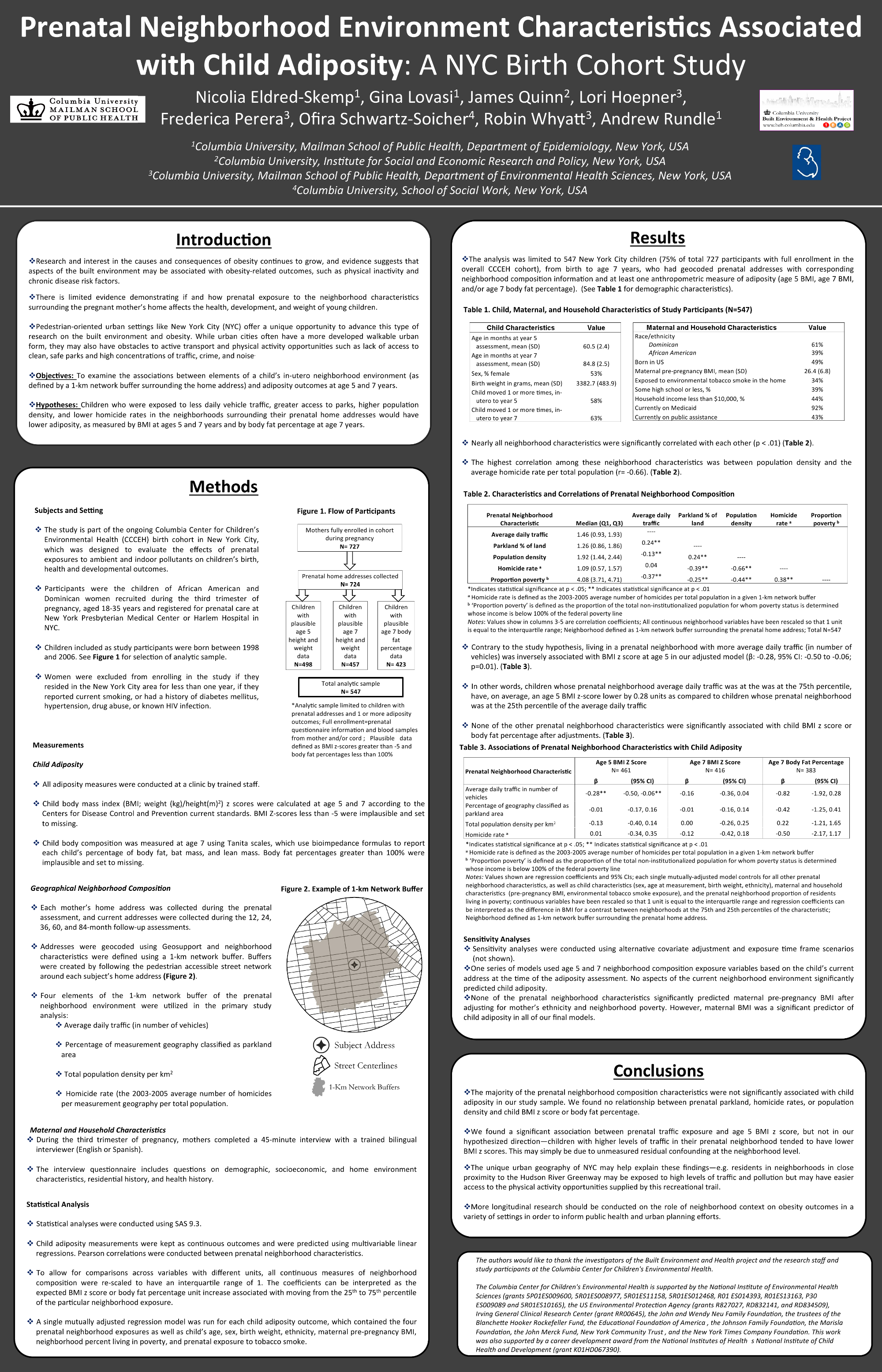
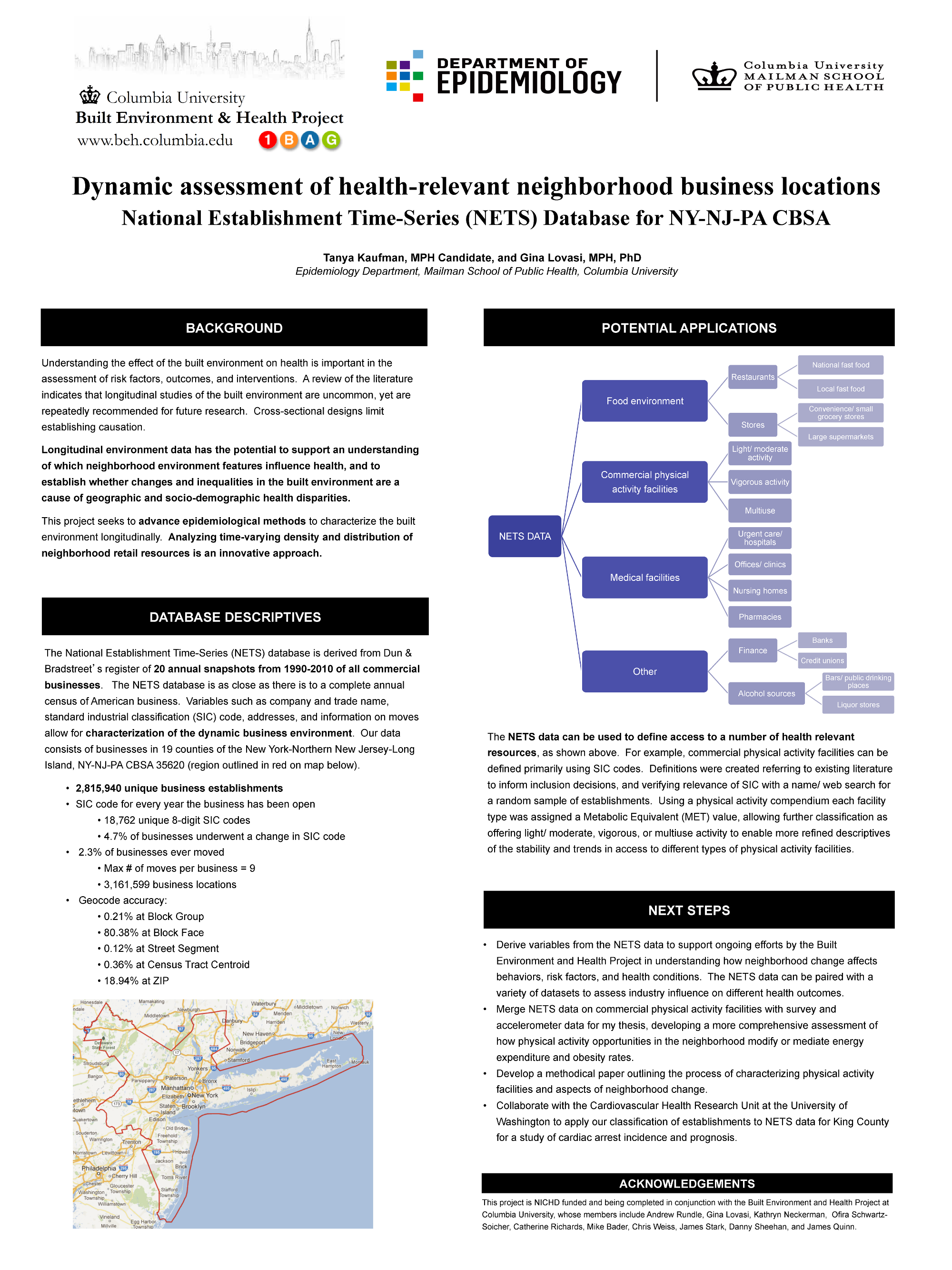
Each year several Masters in Public Health students do there practicums working on BEH projects.  This year we had Christopher “Toph” Allen, Nicolia Eldred-Skemp and Tanya Kaufman working with us.  Toph assessed the accuracy of cell-phone based GPS systems for monitoring walking behaviors in various built environments in NYC.  Nicolia studied the effects neighborhood built environments experienced during early life on childhood obesity at ages 5 and 7.  Tanya worked on developing new measures of neighborhood physical activity resources over the past 20 years using the NETS business listing data.  Nicolia’s (to left) poster presentation won an award at the Department of Epidemiology’s Master’s Student day event.

Toph’s poster – full version

Nicolia’s poster – full version

Tanya’s poster – full version

Posted in Uncategorized | Leave a comment

Neighborhood Aesthetics, Safety and Active Transport

As you’d expect in a city like NYC, many people walk or bike to get around.  This active transportation can be an important component of physical activity, particularly in neighborhoods that make active transportation an attractive and safe option.

Our latest paper, just published in the Active Living Research special issue of Annals of Behavioral Medicine, finds that aesthetic amenities like sidewalk cafes and neighborhood safety (as indicated by lower homicide rates) are associated with more walking and biking for transportation.  This follows on our earlier work (see the previous blog post) linking aesthetic amenities to lower BMI in another large NYC-based population; together these papers suggest that attractive features of neighborhood streets may have a role in supporting active lifestyles and a healthy weight.

However, both of these papers also explore interactions with neighborhood poverty and find that the explanatory power of aesthetic amenities may be weaker or absent in high poverty neighborhoods.  We have likewise found in both populations that the hypothesized associations of walkable urban form with active transportation and BMI, respectively, are weaker in high poverty neighborhoods.  The challenge of identifying and understanding what resources could support physical activity and obesity prevention in high poverty urban settings continues to drive much of our research.

Posted in Active Transport, Aesthetics, Safety | Leave a comment